The Iron Age Forts on Pontesford and Earls Hill

The Iron Age Forts on Pontesford and Earls Hill

The hill has two Iron Age forts and one mysterious bank feature.

The Lower Camp hill fort is just above the carpark. It is a good place to take young children for a picnic or games of hide-and-seek. Please try to keep it clear of dog fouling. The huge Earls Hill Fort encloses the trig point at the summit. A walk round the ramparts gives breathtaking views in every direction.

Between the two forts is a mysterious bank known as the Cross Dyke in the trees at the northern end of the ridge. Our best guess is that it was intended to be part of a larger defensive structure that was never completed.

These features are protected by law. In August Harriet Sharp, an archaeologist from Historic England, came to inspect them and advise us on future management. Her report was generally encouraging. She approved of the work we have done and made suggestions for the long-term protection of the sites.

Ideally, hill forts should not have trees growing on them, but unfortunately both the Lower Camp and the Cross Dyke were covered in plantation forestry in the 1960s. Harriet told us that the established trees on the Lower Camp are not doing much harm and their shade is helping to suppress undergrowth. We can cut back lower limbs to improve the visitor’s view of the fort, but we don’t need to fell them unless they look likely to fall over and pull out their root plates. On the Cross Dyke the situation is worse: plantation trees on the lower side of the bank are reaching maturity and leaning over the bank in the prevailing wind. They need to be felled before they tear out their roots. This is a big job and SWT will seek contractors to do it when funds are available. A big issue to resolve will be what to do with the timber: extraction from the summit site would be difficult, and some may have to be left lying as habitat for invertebrates.

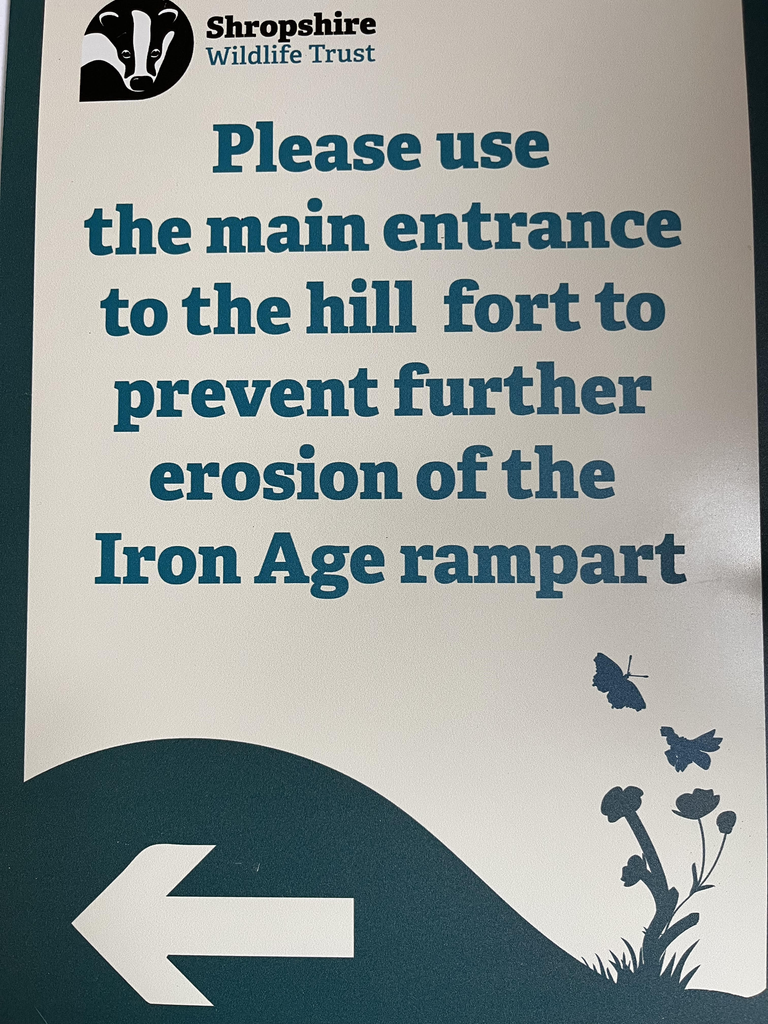
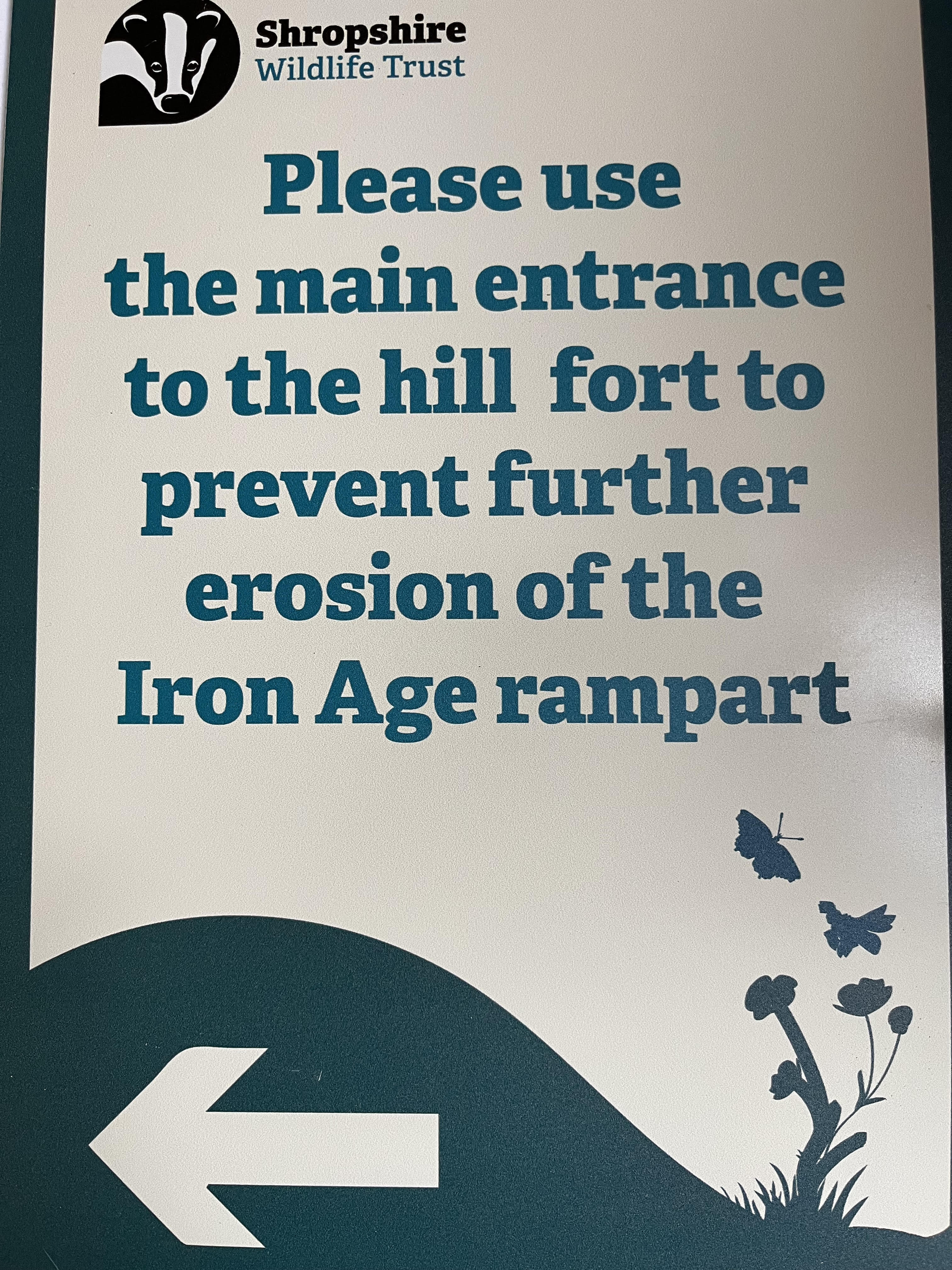
Thankfully Earls Hill Fort has no trees, but it is suffering increased erosion due to more visitors climbing up there. Harriet has asked us to put signs to stop people who have walked up the Craft valley cutting the corner and entering the fort over the rampart, which is being damaged. We will encourage people to use the original Iron Age entrance at the north end of the ridge. She was glad to see no damage from mountain-bikes. If you know young people with bikes, please remind them that they must not use them in the Nature Reserve or on the Scheduled Ancient Monuments. We are very lucky to have Eastridge Woods mountain biking trails only three kilometres away: ask them to go there!

The hill forts are over two thousand years old and in remarkably good repair. We are lucky to have them right on our doorstep.
Outcome of the Public Consultation

Forty people braved a freezing night in November to join the Friends of Pontesford Hill for a public consultation on the future management of the hill. It was an exciting and informative evening: thank you very much to all of you who attended and to those who contributed by email.

In general, people expressed confidence in the direction we are heading. They strongly supported action to improve the existing habitats and to increase diversity. In particular, they supported two new fence lines: one to protect animals on the scree slope from dog attacks, and one to enclose the summit of Pontesford Hill, allowing grazing there to re-establish the acid grassland, and potentially increase the area of the SSRI at some point in the future.

People were broadly happy with our gradual “coppice coup” process of felling plantation conifers and encroaching sycamore along the bulldozer track to replant with mixed deciduous woodland trees, in particular hazel to encourage dormice. This process also favours woodland flowers and birds by opening up the woodland canopy. They supported a new coup area behind “the dens” where children play, to try to restore the lost bird life there. They emphasised that they wanted a gradual process over years, with no clear felling.

During the discussions, we were issued with some new challenges:

  • It was pointed out that our bird boxes, originally used to encourage spotted flycatchers, are now only encouraging great tits and blue tits, which will outcompete the endangered willow tits. This is important as there are historical records of willow tits on the west side of the hill, and a bird which may have been a willow tit was visiting a bird feeder on Grove Lane last year. Our coppice coups on the bulldozer track are ideal habitat, and we have been asked to enhance them by manufacturing nest sites out of decaying silver birch trunks. At the same time, we will remove the old birdboxes to reduce the competition from more robust tits.
  • The “upper ant hill meadow” habitat is declining due to lack of sheep grazing, and in  danger of losing its SSSI status. The issue here, as everywhere else, is the conflict between sheep grazing and dog walking. It was suggested that we ask The Dogs Trust for advice on the way forward, and we had many offers of help with management of stock and signage. People were very proud of the volunteer goat warden scheme we used last year, and we have offers of future help.

The final message was that public affection for the Hill remains as strong as ever, and people want more information about what is going on. We will try to address that communication gap via the village newsletter, posters and social media.

Thank you everyone for your support.

Conservation Grazing with Goats on the Scree

Conservation Grazing with Goats on the Scree
The six Royal Guernsey Goats which were grazing the scree have moved on to new pastures. This experiment in conservation grazing, with a new species monitored by volunteer wardens, was a great success.
Contractors are now putting a stock fence at the bottom of the scree to protect future grazers against the risk of dog attacks, and we hope to have some fresh animals on there soon.

March 2022

March 2022
Volunteers spent a bright, sunny morning on the East flank of Earl’s Hill clearing bramble in order to increase the habitat of the grayling butterfly. The butterfly, also known as the rock grayling, has suffered a serious decline in numbers in recent years.

February 2022

February 2022

After days clearing the third coupe, we planted approximately 200 hazel, oak, hawthorn, rowan and holly whips. Many hands made light work 🙂

January 2022

January 2022

Thanks to a great group of volunteers, many hands made light work of path clearance and stile repair on a mild morning in early January.

At the beginning…..
At the end, looking up the hill.
The stile before…
Starting to clear the path
And at the end, looking down the hill.
And after!

September 2021

September 2021
In September we worked on the ant hill meadow. We plan to continue clearing the meadow during the coming months.
Email: secretarypontesfordhillfriends@gmail.com if you would like more information. We would love more volunteers!
The meadow (the last one that you walk through as you go round the back of the hill towards the scree slope) has suffered under lockdown. Two years of reduced work parties and grazing have allowed bramble to encroach, with gorse, broom and saplings now growing through. We need to act quickly to restore this very special habitat, home to rare spring flowers, butterflies, lizards, birds and the ants themselves.
We cannot use a mechanical flail to cut over the ant hills, so have begun clearing the bramble by hand and rolling it downhill to rot. In Spring, the sheep will be able to get into the cut areas and nibble back the young bramble suckers, which they love. It will take about three years to restore the meadow completely.

Interesting videos

Interesting videos

With its fascinating history and special role within the county, it’s no surprise that Pontesford hill has been the subject of various news clips and short films over the years.

Here you can find links taking you to videos including a documentary film showing local school children honing their skills as natural historians, a clip from BBC radio Shropshire about the success of the locals securing the future of the hill and a few pieces of camera trap footage courtesy of the Shopshire Wildlife Trust showing the diversity of species found on and around the hill.

BBC Radio Shropshire video about how the local people saved the hill
Shropshire Wildlife Trust footage of the wildlife on Pontesford Hill

AGM and new officers

The Friends of Pontesford Hill have managed to hold a “virtual AGM” process and have elected two new officers.

We owe an enormous “thank you” to Christopher Cooke and Brian Simmonds, the departing Chair and Treasurer for their years of work. Hopefully one day soon we will be able to thank them in person.

We welcome our new Chair, Quentin Shaw and Treasurer, John Turford. Our Secretary remains Richard Otto.

In these times it is more important than ever that we keep an up-to-date distribution list of freinds, and our first task will be to try to sort this out.

Enjoy the Hill. Please be thoughtful about your dogs and their waste.

Welcome back, but please remember that dogs should be kept on a lead.

The car park is open once again and we have seen a massive increase in visitors. You will notice how much the Hill benefited from a bit of a rest.

In particular, there is no dog poo or poo bags in evidence. Please try to keep it this way:

On the car park please “bag and bin” dog poo (there is a bin by the main gate).

On the paths please ‘stick and flick’: move poo off the paths into undergrowth by flicking with a stick, a stone, or the side of your boot.

Please never put down a poo bag or hang it on a branch “to collect on the way back”. Too many people forget. Poo bags themselves are an environmental risk.

Please also remember that UK Govt Social Distancing rules advise that dogs should be kept on leads in public spaces. These rules are still in force.

https://www.gov.uk/guidance/coronavirus-covid-19-advice-for-people-with-animals

Some great stuff to watch while on lock-down:

Stewart Edmunds of SWT used a camera trap to capture this amazing footage of wildlife on the Hill last year. Have a look to see some unexpected species just where you go for a walk (and you can also enjoy the beautiful views of the hill in summer: not long to wait now):

https://www.youtube.com/embed/jTD3LjEL-44

Brian Simmonds found this historic educational documentary on Facebook: Harlescott Grange Primary School children on the Hill in, I think, the early ’60s. You will recognize some of the individual trees, but the views have changed. These remarkable children will now be in their 60s or 70s. I wonder if we could identify them and invite them back to the Hill?


https://vimeo.com/127488327